
What a U.S.-Iran Peace Framework Means for Your Portfolio

The U.S. and Iran have announced a preliminary agreement aimed at ending a four-month conflict that has weighed on the global economy. Stock markets have risen, oil prices have dropped, and interest rates have declined in response. Here is what this means for investors and their portfolios.
The agreement, called a "memorandum of understanding," includes reopening the Strait of Hormuz. A final deal is expected within 60 days. However, many details are still unresolved, including questions about Iran’s nuclear program and trade restrictions. Investors should keep in mind that there have been several failed negotiations since the conflict began, and short-term market swings have followed each one.
Oil prices and inflation: possible relief at the pump

Energy prices are the main way that geopolitical conflicts affect everyday consumers and the broader economy. Oil prices had already started falling before the deal was announced, dropping more than 25% from an April peak of $118 per barrel to around $85 per barrel. Gasoline prices followed a similar path, rising above $4.50 per gallon in late May before pulling back toward $4.00 per gallon.
The latest inflation report shows that energy prices rose 23.5% over the past year, with gasoline up 40.5%, pushing overall inflation to 4.2% in May. However, core inflation, which removes the impact of food and energy prices, rose only 2.9%. This suggests that higher oil prices have not spread widely through the rest of the economy. If oil prices keep falling, inflation could ease, which would be helpful for the Federal Reserve as it manages both prices and the job market.
Markets have shown healthy gains across different asset classes this year
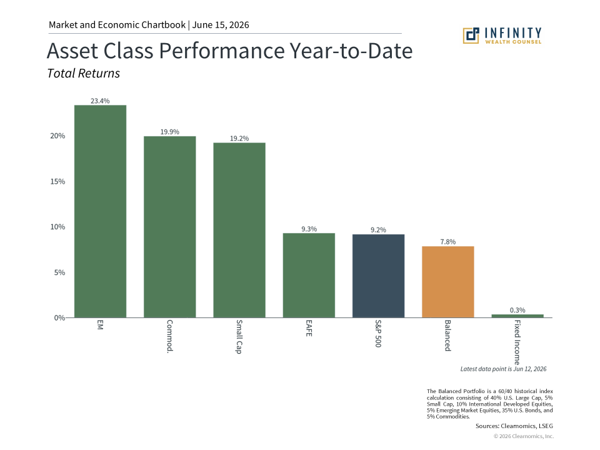
Despite the conflict, many types of investments have performed well in 2026. The U.S. stock market is up around 10% for the year, supported by strong company earnings and a healthy economy. Bonds have helped steady portfolios during turbulent periods, and international stocks have also done well, continuing a trend from the past two years.
Within the stock market, eight of the eleven major sectors have posted positive returns. The energy sector has led the way, gaining about 27% as higher oil prices boosted company revenues. Defensive sectors like Utilities and Consumer Staples also held up well, while Technology has returned roughly 17.5% despite some ups and downs tied to interest rate changes. This highlights the value of holding a variety of investments so that different parts of a portfolio can support each other during uncertain times.
A long-term view helps investors navigate geopolitical and economic events

Over the past century, markets have faced many geopolitical challenges, including wars and oil supply disruptions. While these events often caused short-term volatility, markets typically recovered and moved higher over time. As the chart above shows, long-term performance has been driven more by underlying economic trends than by any single event.
The peace framework is a welcome development. Lower energy prices can reduce inflation, increase what households can afford to spend, and lower costs for businesses. Most importantly, this serves as a reminder that staying invested and keeping a focus on long-term financial goals remains the most reliable approach through uncertain times.
The bottom line? A preliminary U.S.-Iran peace agreement has lifted markets and pushed oil prices lower. For investors, history shows that the best way to navigate geopolitical events is to focus on long-term trends and financial goals.


Comments